| With millions
of Americans and Canadian baby boomers just a bank CD or two away from
retirement, the race to find low-cost retirement destinations is off and
running. That’s particularly true in Mexico and Central America,
where many prospective expat gringos see the potential of stretching their
dollars and living better for less than is possible back home, yet being
within two to four hours by jet from their old home towns.
While there are many exciting choices
south of the border, two contenders in that race, Corozal in Northern
Belize and Boquete in Panama, are already attracting a lot of
lookers and an increasing number of buyers.
These two small
towns, both boasting a high quality of life and low cost of living, are
worth looking at closely to see how they really compare in key areas of
interest to relocating expats and prospective retirees, such as daily living
costs, real estate prices, the cost of home building, acceptance of foreigners
by local residents and overall appeal.
In looking
at the Corozal and Boquete areas, retirees and other expats have to make
a choice between living on the water and speaking mostly English or living
in the mountains and speaking mostly Spanish.
I’ve recently
visited both areas and talked with people who have taken the plunge to
get their perspectives on the pros and cons of the two towns.
PROFILES
OF COROZAL AND BOQUETE
COROZAL
PROFILE - Corozal Town (pronounced Cor-Roh-Zahl) is located in Northern
Belize, just 9 miles south from the Mexican border and less than 90 miles
north of Belize City. Named -- in the Yucatec Maya language -- for
the cohune palms that once were common in the area, Corozal Town has a
picturesque setting on Corozal Bay. Once a trading center of the
ancient Maya, who lived in the area from at least 2000 B.C., in the 19th
century Corozal was settled by Mestizos fleeing the Caste Wars in the Yucatán.
In 1955, much
of the town was destroyed by Hurricane Janet. It was rebuilt in a
combination of Mexican and Caribbean styles. Today, the town is a sleepy
gateway to Belize from the expanding “Mayan Riviera” of Mexico.
The main part of Corozal is laid out at the edge of the gently curving
Corozal Bay, offering one of the most appealing settings in Belize.
By contrast, the town otherwise is of no particular distinction, with ramshackle
storefronts and simple houses with fenced yards keeping barking dogs at
bay. Near town are the “suburbs” of Xaibe, Ranchito, Calcutta and
other villages along the Northern Highway. To the north is the Four Mile
Lagoon and the Consejo area, where several small real estate projects targeting
expats are being developed. Across Corozal Bay are the ruins of Cerros,
the village of Copper Bank and Progresso Lagoon.
Corozal Town’s
population was is around 8,000 and the entire Corozal District, comprising
718 square miles, has a population of around 35,000. About 15 miles
away by boat is the fishing village of Sarteneja. Beyond that, hanging
down from Mexico like a tropical stalactite, is an appendage of the Yucatán
peninsula and, separated from Mexico only by a narrow channel, Belize’s
most popular resort area, Ambergris Caye.
The economy
of Corozal is based on services, importing goods in a duty free zone near
the Mexican border where there also are several small casinos and sugar
cane production. Increasingly, the area is getting income from real
estate and tourism. Corozal and surrounding areas have about a dozen small
hotels, and there has been a mini real estate boom over the past year or
two, with speculators buying up tracts of inexpensive bayfront land near
Corozal Town.
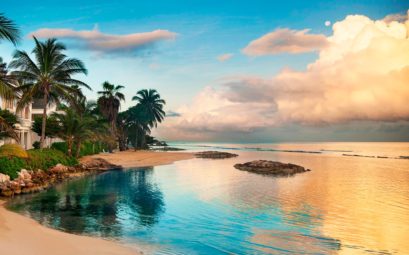
Unlike Ambergris
Caye, Placencia and some other areas of Belize, Corozal is on a shallow
bay, not directly the Caribbean Sea, and has no real beaches. The
waters of the bay are as blue as those elsewhere on the coast or cayes,
however, and the breezes from the water as cooling and constant as any
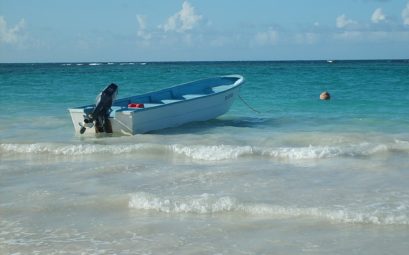
in Belize. Anglers find good fishing for tarpon, bonefish, permit
and other fish, and boating is enjoyable on the protected waters of the
bay. Especially outside of town, you can swim in the warm, clean
water.
The climate
in Corozal is subtropical, similar to that in central or south Florida.
In winter, temperatures may drop to the high 50s F at night, but there’s
never a frost. In spring and summer, the thermometer may hit the
low 90s at midday and drop only to the 70s at night. Bananas, mangos,
citrus and other fruit grow almost like weeds. |
|
| Lan "The-Belize-Answer-Man"
Sluder is editor and publisher of Belize First Magazine and
the author of several books on Belize, including Guide to Mainland Belize
and the new Adapter Kit: Belize. He also updated the Belize sections
of the latest Fodor's and UpClose Central America guidebooks. If he can't
answer your question, he'll find someone who can. Visit Lan's website: |
Belize
First Magazine
|
|
.
By Lan Sluder - How to Live, Retire,
Work or Invest in Belize - The English Speaking, Frost Free Paradise
On The Caribbean Coast - For a certain kind of
person there is a certain kind of place; and for certain people that
place is Belize. Belize - the laid back Caribbean country of Central
America! It's a favorite of those seeking a calmer lifestyle in close
proximity to the wonders of nature. It's also become one of the hottest
expatriate destinations in Caribbean Latin America. ...it's not for everyone,
but it may be for you. If so, there's a new eBook that will take you to
Belize and help you stay there.
Belize
Special Report - Click Here
|
|
.
.
|
The Caribbean Property List
has current Real Estate Listings in the Central American/Caribbean nation
of Belize
|
|
|
.
Belize is
in the hurricane belt, with the greatest risk in September and October.
The last major hurricanes to hit Belize were Keith, in October 2000, which
hit Ambergris Caye and Belize City, and Iris, which struck southern Belize
in October 2001. Neither had an impact in Corozal. Since Hurricane
Janet half a century ago, Northern Belize has not experienced a truly serious
hurricane, although several storms in Belize and Mexico have caused moderate
damage to the area.
Local residents
are primarily Mestizos of mixed Indian and European heritage, with some
Yucatec and other Maya, a few Creoles, along with Chinese, East Indians,
gringos and in nearby Shipyard and Little Belize, quite a few Mennonites
who moved to Belize in the 1950s and 60s.
English is
the official language of Belize, and you can easily get by with English
alone in Corozal Town, although many residents of the district speak Spanish
as a first language and some speak only Spanish. Signs are in English,
distances are measured in miles and local laws are based on the English
Common Law, as in the U.S. and Canada.
Next door is
Chetumal, population around 260,000, capital of the Mexican state of Quintana
Roo, with its good, low-cost medical care and inexpensive shopping.
While Corozal Town has only small grocery stores, inexpensive local restaurants
and little shops, Chetumal has large supermarkets, Wal Mart-style super
centers, department stores, multiplex cinemas and even McDonald’s and Burger
King.
The appeal
of Corozal is clear: Corozaleños are friendly, the crime rate
is lower than in some other areas of Belize, though there has been an increase
in crime of late, and the climate is sunny with less rain than almost anywhere
else in Belize, around 50 inches a year, about the same as Atlanta.
.
 |
 |
 |
| ©
Photos by Robin Sparks |
©
Photos by Robin Sparks |
©
Photos by Robin Sparks |
.
Best of all,
housing and real estate prices are a bargain, with large bayfront building
lots going for US$60,000, bay view lots for less than US$20,000, and modern
large homes built to U.S. standards available for US$100,000 to $200,000.
Belizean style homes are much less, and some expats have built simple but
attractive homes for less than US$50,000. Building costs for concrete
construction run US$35 to $55 or $60 a square foot, and rentals range from
US$200 to $800 or so a month, the latter for a pleasant, modern three or
four-bedroom house.
Most foreign
residents of Corozal say that can live pretty well for less than they could
in the U.S. and Canada. Although gasoline and electric costs are
two to three times higher than back home, taxes, insurance, medical care,
restaurant meals and most personal services are cheaper. A carpenter
or mason, for example, gets only about US$25 a day, and a maid or gardener
around US$15. Grocery prices aren’t a bargain, but local fruits and
any foods grown or made in Belize are very affordable. Chetumal is
nearby for big-ticket purchases.
No one knows
for sure how many foreign retirees and other expats live in the Corozal
Town area, but the best estimates are that the total is around 300 to 400.
Some live in Corozal Town proper, and others live a few miles north in
the Consejo area or in other nearby communities.
Three of Belize's
banks, Scotia Bank, Belize Bank, and Atlantic Bank, have branches in Corozal
Town, and Belize Bank has an ATM that works with foreign-issued ATM cards.
The town has
a Rotary Club and a few other local organizations of interest to foreign
residents. An informal expat association meets monthly for lunch.
Attendance is usually around 40 to 50 people. Some foreign residents
take courses at Corozal Junior College. Tuition costs are nominal.
Corozal Town has a small public library. Local cable TV has more
than 30 channels, some in Spanish but most in English, for under US$20
a month.
.
|
| Living & Investing In Panama
- Find
Out About Living & Investing In Panama - As things continue
to deteriorate inside the United States intelligent people are looking
offshore for a stable relocation safe-haven - Panama has it all - Panama
is affordable - Panama is modern - Panama is two and one-half hours by
air from Florida - Panama is stable - Panama has great real estate - Panama
uses the US Dollar - Panama has almost no crime - Panama has a good climate
- Panama is enviromentally pristine - North Americans, Canadians &
Europeans are welcome in Panama - Find Out About Living & Investing
In Panama - |
DO
IT! - CLICK HERE
|
|
.
|
|
Ultra-Modern Panama City
|
.
|
The Caribbean Property List
has current Real Estate Listings in the Central American/Caribbean nation
of Panama
|
|
.
. |
BOQUETE
PROFILE - After being spotlighted as one of the best places in the
world to retire by Forbes, Fortune and AARP’s Modern Maturity, Boquete
(pronounced Boh-Keh-Teh) has become a hot spot for baby boomers looking
for a retirement location, and the real estate market in Boquete has started
to sizzle.
Boquete is in the Highlands of Chiriquí
(pronounced Chee-Reh-Kee), about 300 miles west of Panama City, and 55
miles northeast of the Costa Rica border at Paso Canoas.
From the Lowlands city of David (pronounced
Dah-Veed), less than 25 miles away, an unpretentious small city of 80,000,
you drive north on a good, paved country road to Boquete. The roadway
slopes gradually upward. David is at about 100 feet elevation.
The town of Boquete is at around 3,000 to 3,700 feet, and the areas just
north of Boquete are at 4,000 to 6,000 feet, with Volcan Baru topping out
at 11,411 feet.
As you enter Boquete, the red zinc
and tile roofs of the town are spread out in a valley below you.
A good viewing point is the IPAC (Tourism Panama) office, in a handsome
building on the south side of town. The name Boquete means “between
two mountains.” The town has a population of around 5,000, with close
to 16,000 people in the entire Boquete district.
Boquete is also nicknamed “the city
of flowers and coffee,” and both are in abundance here. Flowers and
tropical plants grow in lush arrays around Boquete. Wild impatiens
cling to the mountainsides, orchids are in the trees, and roses, bougainvillea
and colea are in many yards. Eucalyptus trees, silvery green,
add texture to the hillsides.
About 50,000 acres of coffee is in
production in Panama, and the best of the country’s Arabica coffee is grown
above 3,000 feet in the Chiriquí Highlands. The highest quality
coffee is shade-grown, organic and handpicked. Kotowa, Café
Ruiz, Hacienda La Esmeralda and Lamastus Family Estates are among the higher
quality coffee operations in Boquete. The coffee beans turn cherry
red and are harvested in this area in October and November.
Each January, Boquete celebrates its twin passions with the Festival de
Flores y Café. In April, there is an orchid festival.
The dark, rich volcanic soil makes
the Highlands the breadbasket of Panama. Above Boquete and around
Volcan and Cerro Punta large fields of onions, potatoes and other vegetables
are intensely cultivated.
With more than 500 American, Canadian
and other expats living at least part of the year in Boquete, and with
increasing tourism from both foreigners and Panamanians, a number
of new restaurants and tourism activities have sprung up. The downtown
area, basically only two streets wide, has a dozen or so restaurants, a
new deli with a selection of imported items, and two well-stocked groceries.
The climate here is dubbed “eternal
spring.” While it is spring like, at times it can get warm during
the day, especially in Boquete town and south of town at the lower elevations.
Temps in the high 70s or low 80s F. are not unusual. At night, though,
it cools down. Most homes require neither air-conditioning nor heat,
except perhaps for a fireplace, although interestingly the tourism office
in Boquete does have central air conditioning. At the higher elevations
around Cerro Punta and up Volcan Baru, it can get positively chilly, and
you may need a sweater at night. Boquete and the Highlands get considerable
rain. One weather station near Boquete reported an average of about
131 inches of rain annually, two to three times the average in much of
the U.S. Southeast. While rain can come in torrents, often it comes
as a bajareque, or drizzle, in the afternoon. When that happens,
rainbows are common.
Panama is south of the hurricane
belt, but earthquakes are possible. Volcan Baru, while dormant for
at least 800 years, could awaken.
Residents of Boquete have access
to good medical care at hospitals and clinics in David, about a half hour
away. |
...
|